Translating AI output in Aimogen is an explicit, controlled operation, not an automatic side effect of content generation. Aimogen will never silently translate content on its own. Translation only happens when you clearly instruct the AI to do so or when you work inside a language-specific context created by your multilingual setup.
This design is intentional. Automatic translation without intent causes SEO issues, editorial confusion, and content drift.
When you want to translate AI output, there are two correct and supported approaches, depending on how your site is structured.
The first approach is translation via AI Content Editing. In this workflow, you already have content in one language and you want a translated version in another. You create or open the target-language post using your translation plugin, then use AI Content Editing with an explicit translation instruction. The AI receives the original text and rewrites it in the target language. The result is saved as normal WordPress content, and WordPress revisions apply. Nothing is auto-synced, nothing is overwritten outside the current language context.
You can also use Google Translate service, to automatically translate content generated in ‘Bulk AI Post Creators’. You can find the settings to enable this, in ‘Settings’ menu -> ‘Bulk Posts’ tab.
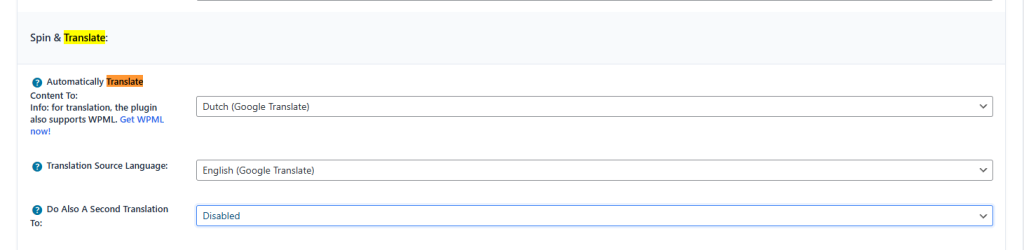
This method is ideal when you want editorial control, revision safety, and clean separation between languages.
The second approach is direct generation in the target language. Instead of generating content in one language and translating it afterward, you instruct the AI to generate the content directly in the desired language. This happens by working inside the correct language context or by explicitly specifying the target language in the prompt. This approach usually produces more natural phrasing than post-translation, especially for marketing or editorial content.
Both approaches are valid. The key difference is whether you are transforming existing content or creating new content natively in another language.
Aimogen does not infer translation intent. If you generate content in English and do not explicitly request translation, the output remains English, even if your site is multilingual. Likewise, if you edit Spanish content without asking for translation, the AI will rewrite it in Spanish, not convert it to another language. Language preservation is the default behavior.
For bulk workflows, translation works the same way. Each language version is treated as a separate post. Bulk AI Content Editing can be used to translate multiple posts, but only when those posts already exist in the target language context. There is no “translate everything automatically” switch, by design.
Chatbots follow similar rules. A chatbot responds in the language implied by configuration, page context, or user input. It does not translate responses unless instructed. If you want a chatbot to act as a translator, that behavior must be explicitly defined in its instructions or workflows.
Embeddings deserve special attention. Embeddings are language-specific. Translating AI output does not update embeddings automatically, and embeddings should not mix languages. If you translate content that is used for embeddings, you must regenerate embeddings for the translated language separately. Otherwise, retrieval quality will degrade.
In REST API usage, translation is also explicit. API-triggered executions do not auto-detect or auto-translate language. The caller must define whether the task is generation, rewriting, or translation, and must target the correct language context. This keeps API usage predictable and auditable.
A common mistake is assuming that multilingual plugins imply automatic translation. They do not. They manage language relationships. Aimogen generates or edits content inside those relationships only when you instruct it to do so.
Best practice is to treat translation as a deliberate editorial action, not as a background convenience. Decide whether you want native-language generation or AI-assisted translation, test instructions in the Playground, apply changes in the correct language context, and regenerate embeddings if needed. This keeps multilingual content accurate, SEO-safe, and maintainable over time.
In short, translating AI output in Aimogen is precise, intentional, and reversible. The AI translates when you ask it to, stays in the correct language when you don’t, and never crosses language boundaries silently.


